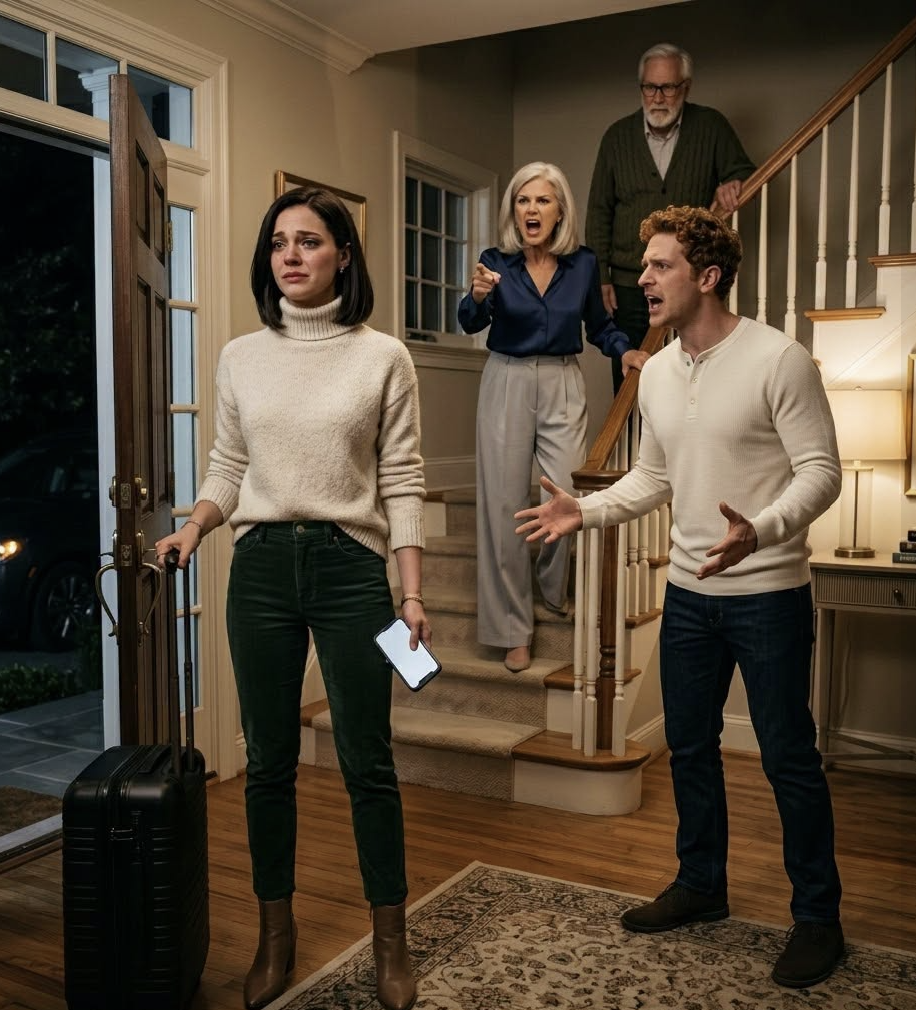
Below that sat several legal documents.
I read the first paragraph.
Then the second.
My hands began to shake.
“What is it?”
Caleb asked.
Marisol stood.
I looked at my son.
“These aren’t family papers.”
Richard and Victoria hadn’t come only because of surgery.
They had come because Caleb had turned twenty-one three weeks earlier.
And according to a trust established by my grandfather, Arthur Ashford,
the first grandchild of Richard Ashford automatically received thirty-four percent of the voting shares in Ashford Medical Group upon reaching twenty-one.
Thirty-four percent.
Combined with shares controlled by an independent charitable trust, it was enough to remove Richard as chairman.
Caleb stared at me.
“I own part of their company?”
“Apparently.”
He flipped through the paperwork.
“Then what’s this?”
I examined the final page.
A transfer agreement.
Caleb would relinquish his voting rights to Richard in exchange for five million dollars.
My blood went cold.
“They wanted you to sign this.”
Caleb laughed once.
“So they didn’t come looking for their grandson.”
Marisol spoke from behind us.
“No.”
Her voice sounded strange.
“They came looking for his signature.”
I confronted Richard immediately.
He didn’t deny it.
“You don’t understand the company,” he said.
“We understand the words ‘irrevocable transfer,’” Caleb replied.
Richard sat upright in his hospital bed.
“Ashford Medical employs twelve thousand people.
It cannot be controlled by a twenty-one-year-old resident.”
“Then your grandfather shouldn’t have written the trust that way.”
Richard’s expression changed.
“You knew Arthur?”
Caleb asked.
Richard ignored him.
Instead he stared at Marisol, who stood near the door.
“Why is she here?”
Marisol’s hand tightened around her cane.
“You remember me.”
Victoria went pale.
I looked between them.
“What’s happening?”
Richard’s voice dropped.
“You were a nurse at Ashford Memorial.”
“Twenty-four years,” Marisol said.
My chest tightened.
She had never told me that.
“You said you worked at County.”
“I did afterward.”
Richard’s face had become hard.
“She was terminated.”
Marisol smiled without humor.
“That’s one word for it.”
“Marisol?”
I whispered.
She looked at me.
For twenty-one years, this woman had been closer to me than my own mother.
And suddenly I realized there was an entire chapter of her life she had hidden.
“I knew your grandfather Arthur,” she said.
Richard swung his legs toward the side of the bed.
“Enough.”
“No,” Marisol said.
One word.
But it changed the room.
“Not anymore.”
She opened her handbag and removed a faded envelope.
“I promised Arthur I would give this to Elena when the right moment came.”
My father stared at the envelope as if it were a loaded gun.
“What did you do?”
Marisol ignored him.
She handed it to me.
My name was written across the front.
Not Elena Morales.
Elena Ashford.
The handwriting looked old.
The letter inside began:
My dear Elena, if you’re reading this, then Richard has finally been forced to face the thing he fears most—the truth.
I stopped breathing.
My grandfather Arthur had died when I was fifteen.
I remembered him as warm but distant, constantly fighting with my father about the direction of the family medical company.
According to the letter, Arthur had discovered that Richard was manipulating complication reports at two surgical centers to protect expansion deals.
Not inventing patient deaths.
Not intentionally harming people.
But hiding unacceptable complication rates.
Patients had suffered.
Arthur threatened to remove him.
Then Arthur became ill.
He died months later.
The official explanation was heart failure.
Before his death, he rewrote the family trust.
He knew Richard obsessed over bloodlines and legacy.
So Arthur created a safeguard.
The first grandchild would receive thirty-four percent ownership at twenty-one.
If Richard became the man Arthur feared he was becoming, the next generation would have the power to stop him.
“Why didn’t anyone tell me?”
I asked.
Marisol’s eyes filled.
“Because Arthur asked me not to unless the trust became necessary.”
Richard laughed bitterly.
“My father was senile.”
“He passed three competency evaluations.”
“Enough!”
Richard ripped a monitor lead loose.
A nurse rushed in.
I held up my hand.
“It’s okay.”
But it wasn’t.
Nothing about the room was okay.
Caleb stood silent, holding the letter.
Then he looked at Richard.
“So this is why you came.”
Richard said nothing.
“You need Mom to save your life, and you need me to save your company.”
Victoria started crying.
“Caleb, please understand—”
He turned toward her.
“Did you know?”
She lowered her head.
That was answer enough.
Richard’s surgery was scheduled for Friday.
I almost withdrew.
Jonathan Keller offered to fly in.
“You don’t owe him this,” Caleb told me the night before.
We were sitting in my office.
“No.”
“Then why are you still doing it?”
I looked through the window at the city.