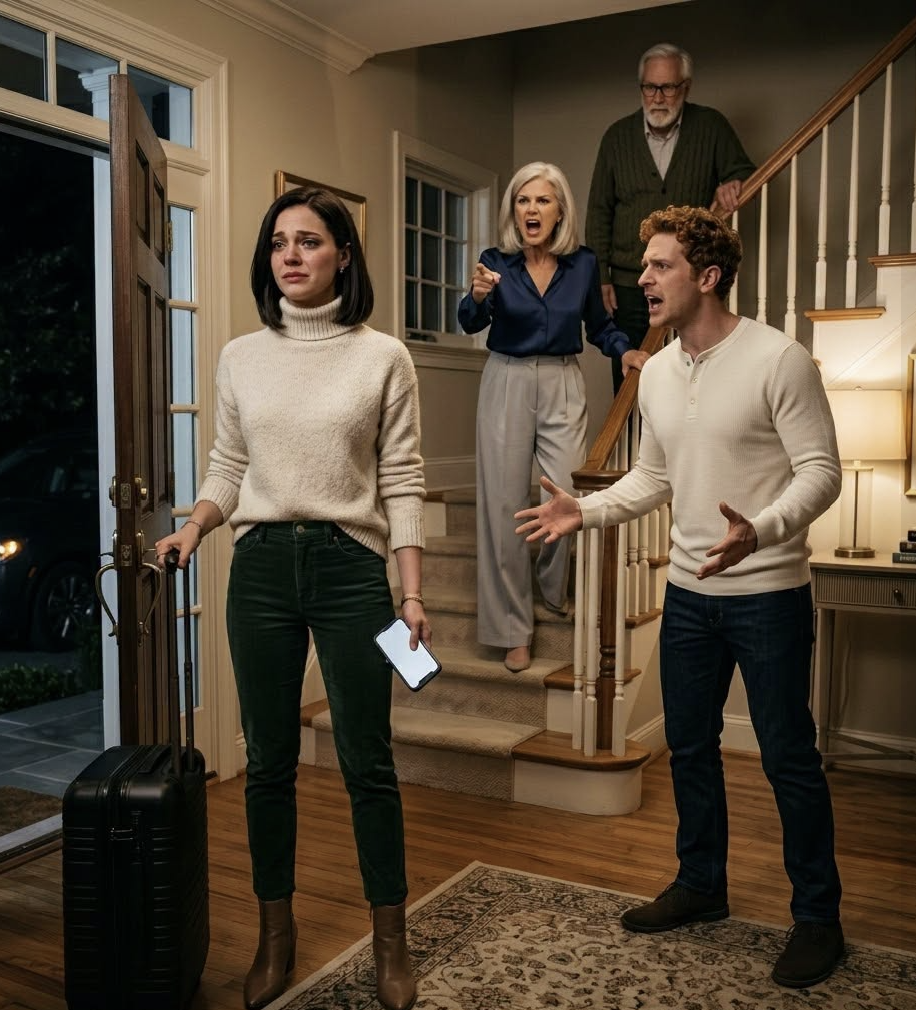
His legacy standing fifteen feet away.
Richard straightened his jacket and produced the polished public smile I remembered from magazine covers.
“Caleb?”
My son approached.
Richard extended his hand.
“Son, I’m your grandfather.”
Caleb looked at the hand.
Then at Richard.
“I know exactly who you are.”
The smile vanished.
“I’m sure you’ve heard an emotional version of events.”
“I heard the version where you left my seventeen-year-old mother in freezing weather with fifty dollars.”
Richard glanced at me.
“Naturally.”
Caleb’s eyes sharpened.
“You mean accurately.”
My mother stepped forward.
“Caleb, we didn’t come to argue.”
“Then why did you come?”
Silence.
Richard looked around.
Then something changed in his face.
The arrogance cracked.
Beneath it was fear.
Real fear.
“I need surgery.”
His diagnosis was serious.
An extremely rare aortic aneurysm wrapped around tissue damaged by an old surgical repair.
Three surgeons had declined the case.
A fourth told him that attempting it conventionally could kill him on the table.
St.
Matthew had recently pioneered a hybrid procedure combining vascular reconstruction and minimally invasive cardiac support.
Only one attending surgeon at the hospital had performed enough complex variations to qualify.
Richard had assumed Caleb was involved in the program.
That was partly why he’d come.
“My doctors said the specialist here is the best person in the region,” Richard said.
Caleb looked at him.
“You came here thinking that specialist was me?”
Richard nodded.
Caleb glanced toward me.
Then he almost smiled.
“Nei.”
My mother whispered, “Then who?”
Caleb stepped aside.
“The person you need is my mother.”
Richard actually laughed.
Not because it was funny.
Because reality had become too absurd for him to accept.
“Elena?”
I held his gaze.
“Ja.”
“You expect me to believe—”
“I trained under Dr.
Jonathan Keller.”
His face changed.
Everyone in cardiothoracic surgery knew Keller.
“I co-developed the modified hybrid approach your consulting physician recommended.”
My father’s mouth opened.
Nothing came out.
Caleb crossed his arms.
“So the seventeen-year-old you threw into a snowstorm is now the surgeon who might be able to keep you alive.”
My mother sat down abruptly.
Richard looked at me.
And for the first time in my entire life, my father looked at me without superiority.
He looked at me with need.
“I won’t beg,” he said.
We were inside a private consultation room thirty minutes later.
“That’s fortunate,” I replied.
“I wouldn’t enjoy it.”
Victoria whispered, “Elena.”
I opened Richard’s imaging scans.
His condition was worse than I expected.
The aneurysm had expanded significantly.
Without intervention, rupture was possible at any time.
Weeks.
Months.
No responsible physician could predict.
My medical instincts pushed aside everything else.
That was the inconvenient thing about becoming the person I wanted to be.
Compassion didn’t always arrive for people who deserved it.
Sometimes it arrived because
you deserved to remain compassionate
.
“I can operate,” I said.
Richard leaned forward.
“But?”
“There are risks.”
“I understand risks.”
“I don’t think you do.”
I turned the screen.
“Your previous graft has deteriorated.
The aneurysm is pressing against structures that make open repair extremely dangerous.
There’s a significant chance of stroke, kidney injury, paralysis, or death.”
Victoria gripped his hand.
I had never seen her do that.
“We’ll accept the risks,” she said.
I looked at Richard.
“Will you?”
His gaze remained on mine.
“Yes.”
I stood.
“Then my team will review everything.”
My father frowned.
“That’s all?”
“What were you expecting?”
He hesitated.
“Conditions.”
“Oh, I have conditions.”
Victoria stiffened.
“Name them.”
“You don’t speak to Caleb without his consent.”
My father’s face hardened.
“You don’t use this hospitalization to manipulate him.”
“Elena—”
“And you never describe what happened twenty-one years ago as a misunderstanding.”
Silence.
“If you want me as your surgeon, you will tell the truth.”
Richard’s eyes narrowed.
“Are you threatening to deny me medical care?”
“No.
If I decide I can’t operate because of our personal history, I’ll find someone qualified.
Your life will not depend on whether I forgive you.
”
That landed harder than anger would have.
Because suddenly he understood.
I had power.
And I was refusing to use it the way he would have.
That afternoon, Marisol came to the hospital.
She was seventy-three now and walked with a cane.
When I told her who had arrived, she sat very still.
“Richard Ashford.”
“You remember him?”
Something flickered in her expression.
I noticed it.
“Marisol?”
She looked away.
“Of course I remember the name.”
But that wasn’t what I had asked.
Before I could push further, Caleb entered.
“Mom, you need to see something.”
He held a leather folder.
My stomach tightened.
“Where did you get that?”
“Grandmother.”
He said the word like a diagnosis.
“She told me it was family paperwork.”
I opened it.
On top was a letter.
ASHFORD LEGACY TRUST.