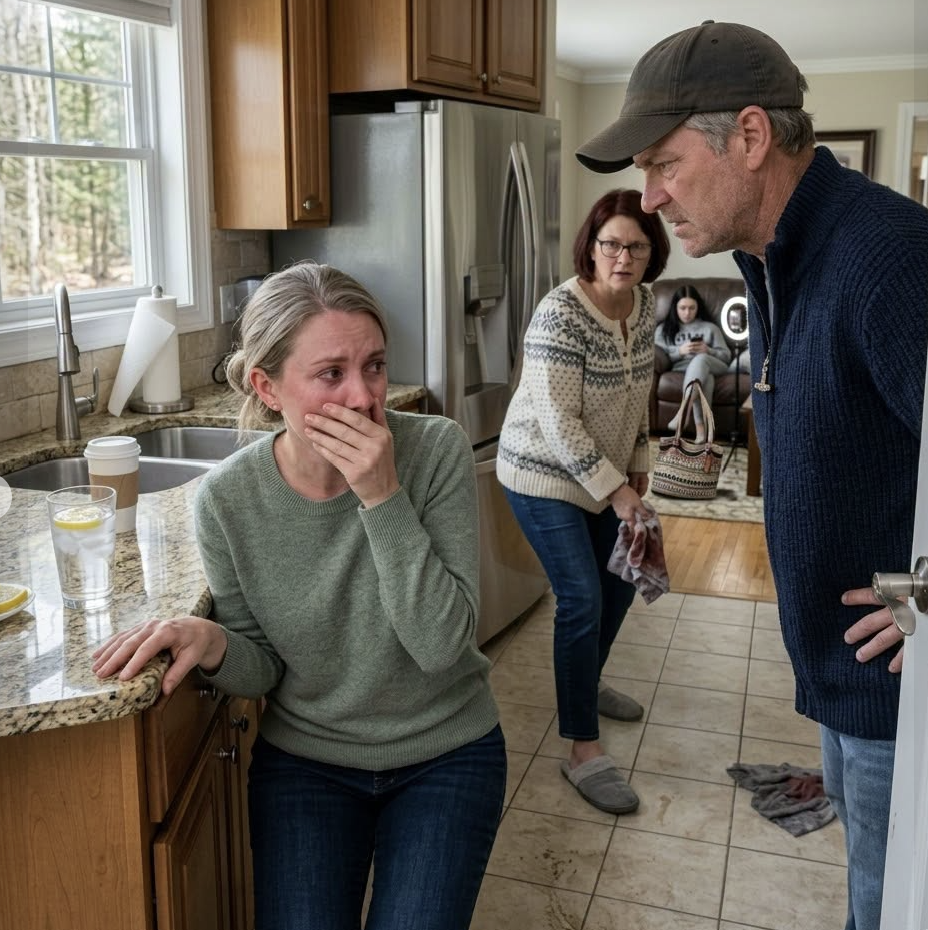
“I want you to understand that being family doesn’t give anyone unlimited access to me,” I said. “If we share something privately, it stays private. If we say no to a photograph, you don’t take one anyway. If we ask someone to stop, you don’t tell us to tolerate it because that’s just how they are.”
Derek nodded slowly.
“And Vanessa?”
“She doesn’t need to like me. We don’t need to be close. But she does need to respect our boundaries if she wants to be part of our lives.”
He swallowed.
“I’ll talk to her.”
I shook my head.
“You can talk to her, but I’m not asking you to manage her. She’s an adult. She can decide how she wants to behave.”
He stared at me for a long moment.
Then he nodded again.
“I’m sorry,” he said.
Those two words were quiet.
They didn’t undo three years of hurt. They didn’t erase the cruel comments about my miscarriage or the photographs Vanessa had posted without permission.
But they were the first words Derek had said that morning that weren’t an excuse.
I accepted them without pretending everything was fixed.
When he stood to leave, he paused at the door.
“For what it’s worth, I think you and Mason chose a beautiful name.”
My throat tightened.
“Thank you.”
After he left, Mason sat beside me.
“Do you think he’ll change?”
“I don’t know.”
“Do you think Vanessa will?”
I leaned against his shoulder.
“I don’t know that either.”
He wrapped his arm around me.
“But I know what we’ll do if they don’t,” I added.
And that was enough.
Two weeks later, our son arrived.
His birth was exhausting, frightening, and beautiful in ways I couldn’t have imagined.
Mason held my hand through every contraction. He cried when he heard our baby’s first cry, and I cried when the nurse placed our son against my chest.
For a long time, the three of us stayed in that quiet hospital room.
No cameras.
No social media.
No audience.
Just a mother, a father, and the little boy they had waited so long to meet.
Mason brushed a finger across our son’s cheek.
“Hello, sweetheart,” he whispered.
I looked at the tiny face resting against me.
We had chosen his name together. We had protected it through months of appointments, difficult conversations, and sleepless nights.
And now, finally, it belonged to the person who would carry it through his own life.
We took a photograph.
Mason’s hand was wrapped around our son’s tiny fingers, and my hospital bracelet was visible beside his little blanket.
I posted it the following afternoon.
The caption was simple.
“Our greatest joy has arrived. Welcome to the world, [BABY’S NAME]. You were loved long before we met you, and we will spend our lives making sure you never have to question that.”
Within minutes, the congratulations began.
My friends were kind. Our relatives sent messages. Alyssa called and cried happy tears over the phone.
And Vanessa?
She sent a private message.
“Congratulations. He’s beautiful. I hope we can put everything behind us.”
I read it twice.
Then I replied.
“Thank you. We’re focusing on the baby right now. If we are going to move forward, I need to see our boundaries respected consistently, not just hear that everyone wants to move on.”
She didn’t respond.
And that was fine.
I didn’t need her approval to enjoy my son’s arrival.
A week later, Derek visited us.
He came alone and brought dinner. Before he entered the house, he asked whether it was a good time.
Before taking out his phone, he asked whether we were comfortable with a photograph.
Before leaving, he asked when we might be ready for another visit.
They were small things.
But they were different.
I couldn’t know whether the change would last. Trust would have to be rebuilt slowly, through actions rather than promises.
For now, I let the visit be what it was.
A beginning.
Three months later, I looked back at the original Facebook post.
Vanessa had deleted it, but screenshots remained in the family group chat. The incident had become one of those uncomfortable stories people referred to in hushed voices when they thought I couldn’t hear.
I no longer felt the urge to defend myself every time someone mentioned it.
I had learned something I wished I had understood years earlier.
Sometimes, keeping the peace means asking the person who was hurt to swallow the hurt so everyone else can remain comfortable.
That isn’t peace.
It’s silence.
And silence had cost me too much already.