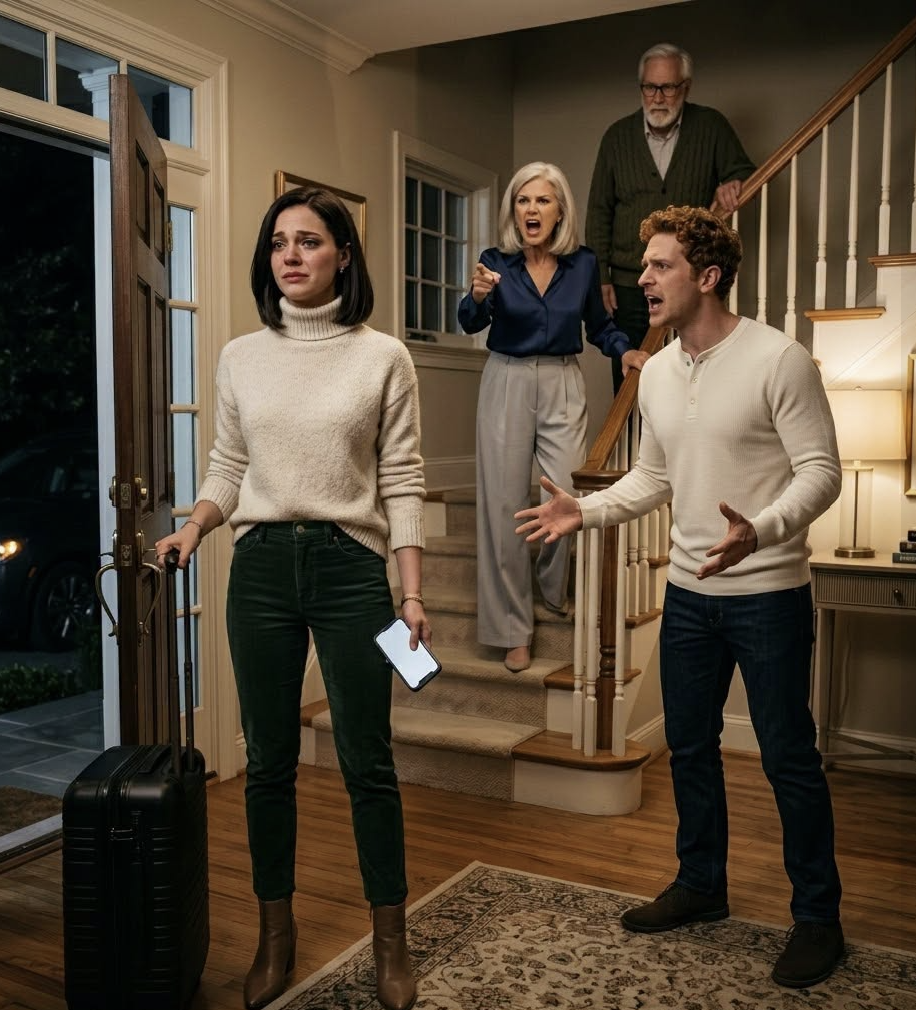
She looked at me.
“Not before.”
That distinction mattered to her.
Maybe it always would.
I reached over and squeezed her hand.
“We don’t get to change before.”
She cried.
So did I.
It was the first time I had cried over the marriage in months.
One year after the dinner, Collins Precision was profitable again.
For the first time in almost a decade, employee bonuses were fully funded.
I refused the CEO position.
Instead, we hired a woman named Dana Pierce who had spent twenty-five years rebuilding troubled manufacturing companies.
She was brilliant.
Demanding.
And entirely unimpressed by family names.
I liked her immediately.
I converted a portion of my shares into an employee ownership program.
Martin called it financially unusual.
I called it insurance.
If another Richard ever came along, two hundred workers would have a louder voice.
The main house stayed empty for months.
Then I sold it.
People were surprised.
“After everything, why let it go?”
Lydia asked.
Because sometimes ownership isn’t the same as belonging.
That house had become a monument to a version of my life I no longer wanted.
The cottage became home.
I repaired the porch.
Painted the kitchen.
Planted lavender where my grandmother used to grow tomatoes.
And one rainy October afternoon, I finally took the broken crystal pieces to an artist.
“I can’t restore the glass,” she told me.
“I know.”
“What do you want me to make?”
I thought about that.
Then smiled.
“Something that doesn’t pretend it was never broken.”
Six weeks later, she returned with a small stained-glass sun catcher.
My grandmother’s crystal formed the center.
When afternoon light hit it, tiny rainbows scattered across the walls.
Broken.
Reassembled.
Different.
Beautiful.
I hung it in the kitchen window.
I thought that was the ending.
It wasn’t.
The real ending arrived thirteen months after the night Richard grounded me.
Martin came to the cottage carrying an old manila envelope.
“I found this while closing one of the legacy files,” he said.
“What is it?”
“Something your grandmother left with my father.”
Martin’s father had been her attorney before Martin inherited the practice.
The envelope was addressed to me.
The handwriting was unmistakable.
My grandmother’s.
My chest tightened.
Inside was a single letter.
I unfolded it carefully.
Dear Helen,
If you’re reading this, someone has probably told you that generosity is your greatest weakness.
I stopped.
Martin watched silently.
I continued.
They are wrong.
Your greatest danger will never be that you give too much.
It will be believing that giving someone love gives them permission to take.
My eyes blurred.
The next paragraph broke me.
One day you may have to choose between preserving something because you loved what it once was and letting it break because it has become something harmful.
Choose yourself without shame.
I pressed my hand over my mouth.
Martin looked toward the window.
Toward the crystal hanging in the sunlight.
“There is something else,” he said.
I looked up.
“What?”
He turned the letter over.
On the back, in my grandmother’s handwriting, were five words:
Broken crystal still reflects light.
I laughed through tears.
Of course she hadn’t meant the wineglass.
She had died years before Tyler ever touched it.
She meant me.
Or maybe people like me.
People who believed endurance was the same as loyalty.
People who kept repairing everyone else’s lives while pretending they weren’t cracking.
I looked at the sun catcher.
Light passed through the broken pieces and painted the kitchen walls in gold, blue, violet, and red.
For months, I had thought Tyler destroying that glass was the cruelest moment of the entire story.
I had been wrong.
It was the moment everything hidden became visible.
The theft.
The forgery.
The manipulation.
The recordings.
The marriage I had been desperately trying to preserve.
If Tyler hadn’t broken that glass, I might have transferred the forty thousand dollars.
If Richard hadn’t humiliated me, I might not have called Martin.
If I hadn’t activated the separation agreement, the audit might not have begun.
And if the audit hadn’t begun, Richard might eventually have placed one of those “tax documents” in front of me on a busy afternoon.
Maybe I would have signed.
Maybe I would have lost far more than a marriage.
That night, I sat alone on the porch as sunset turned the lake copper.
My phone buzzed.
Unknown number.
I almost ignored it.
Then I opened the message.
It was Richard.
Only three sentences.
I drove past the old house today.
Someone else lives there now.
I finally understand what I lost.
I stared at the screen.
A year earlier, I would have answered.
Explained.
Comforted.
Maybe even forgiven too quickly.
Instead, I deleted the message.
Not because I hated him.
I didn’t.