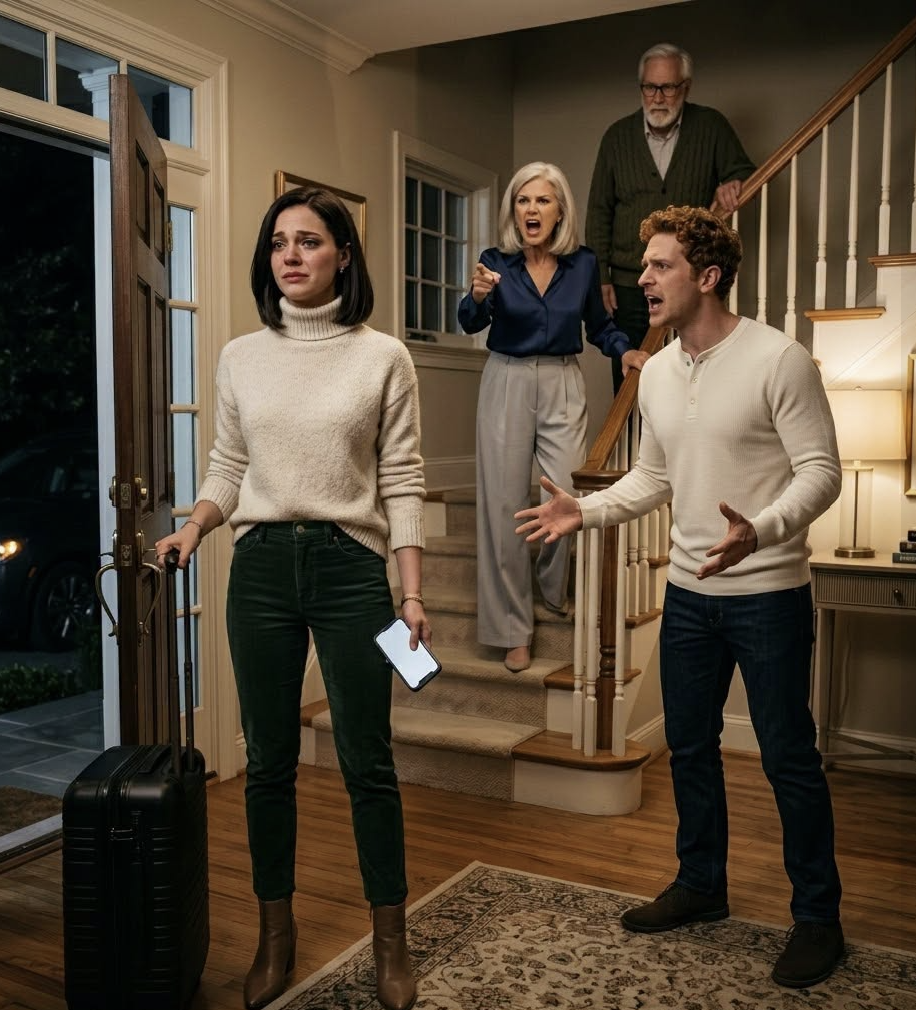
“I invited him,” she said nervously.
Dad lifted both hands.
“I can leave.”
For a moment, the old anger returned.
Then I remembered the letter.
I looked at him.
“You wrote it.”
He nodded.
“Every word.”
Snow collected in his gray hair.
He seemed smaller than I remembered.
Not because I had defeated him.
Because I had finally stopped seeing him as someone whose approval determined who I was.
He was just a flawed man standing in my driveway.
“Grandma may throw you out,” I warned.
“I figured.”
“And you’re not fixing anything.”
He almost smiled.
“Understood.”
I stepped aside.
Dad walked toward the garage.
Then he stopped beside the Charger.
He looked at it for a long moment.
“Still think you should’ve kept the original transmission.”
I stared at him.
He looked terrified.
Then I laughed so hard I had to grab the roof of the car.
He started laughing too.
Grandma shouted from inside:
“Daniel, if that’s you, I hope you brought pie!”
Dad closed his eyes.
“I didn’t.”
I shook my head.
“Then you’re on your own.”
He walked inside.
I stayed outside another minute.
The snow came down harder.
Through the garage windows I could see Ava setting plates on the table.
Dad talking awkwardly with Luis.
Grandma scolding everybody.
Nothing was perfect.
Nothing had been erased.
And nobody had magically become the family I had always wanted.
But something had changed.
I no longer needed them to become different in order for me to become free.
I had my shop.
My work.
My name.
My money.
My boundaries.
My people.
And most importantly, I had finally learned that being useful and being loved were not the same thing.
For years, my family had only seemed to want me when something was broken.
A roof.
A car.
A bill.
A lie.
But I wasn’t born to spend my life repairing people who were willing to keep breaking me.
I looked at the Charger one last time, switched off the outside lights, and walked toward the laughter inside.
That was when my phone buzzed.
A message from Charles Hayes.
Happy Thanksgiving.
One question: would you be interested in restoring a 1970 Plymouth Superbird for a private collection?
Owner specifically requested you.
I smiled.
Then I noticed the photograph attached beneath the message.
The Superbird was battered but unmistakable.
Petty Blue.
Original wing.
Numbers-matching engine.
A restoration most builders dreamed about once in their entire careers.
Under the photograph was the client’s name.
I read it twice.
Then laughed.
Because after everything my family had done trying to use my work to impress Logan Hayes and his father,
the anonymous collector requesting me personally was neither Logan nor Charles.
It was the man who had owned the Charger before me.
The man I had bought it from for four thousand dollars when I was twenty-two.
The elderly seller who had shaken my hand, looked at the half-dead car on his property, and said:
“Promise me you’ll make somebody care about her again.”
His name was Henry Bennett.
Mr.
Bennett.
The same quiet customer whose pickup had been sitting in my garage the morning Mom called to uninvite me from Thanksgiving.
The same man who had eaten turkey in my shop.
The same man who had watched my career without once telling me that he owned one of the largest private Mopar collections in the country.
I called him immediately.
He answered on the second ring.
“You finally figured it out?”
I stared through the window at him sitting at my Thanksgiving table, grinning at his phone.
“You could’ve told me.”
“And ruin the surprise?”
“You own the Superbird?”
“Among other things.”
I laughed.
“Why me?”
His voice softened.
“Because years ago, I sold a broken Charger to a twenty-two-year-old girl everyone else underestimated.”
I looked toward the black car beneath the lights.
“And?”
“And she made somebody care about it again.”
My eyes filled.
Across the garage, Dad caught my gaze.
Ava did too.
Grandma smiled.
Mr.
Bennett raised his glass.
And suddenly I understood the strangest part of the whole story.
My family had spent years trying to convince important people that they were responsible for my success.
But the people who truly mattered had been watching quietly all along.
They knew exactly who had done the work.
And finally—
So did I.